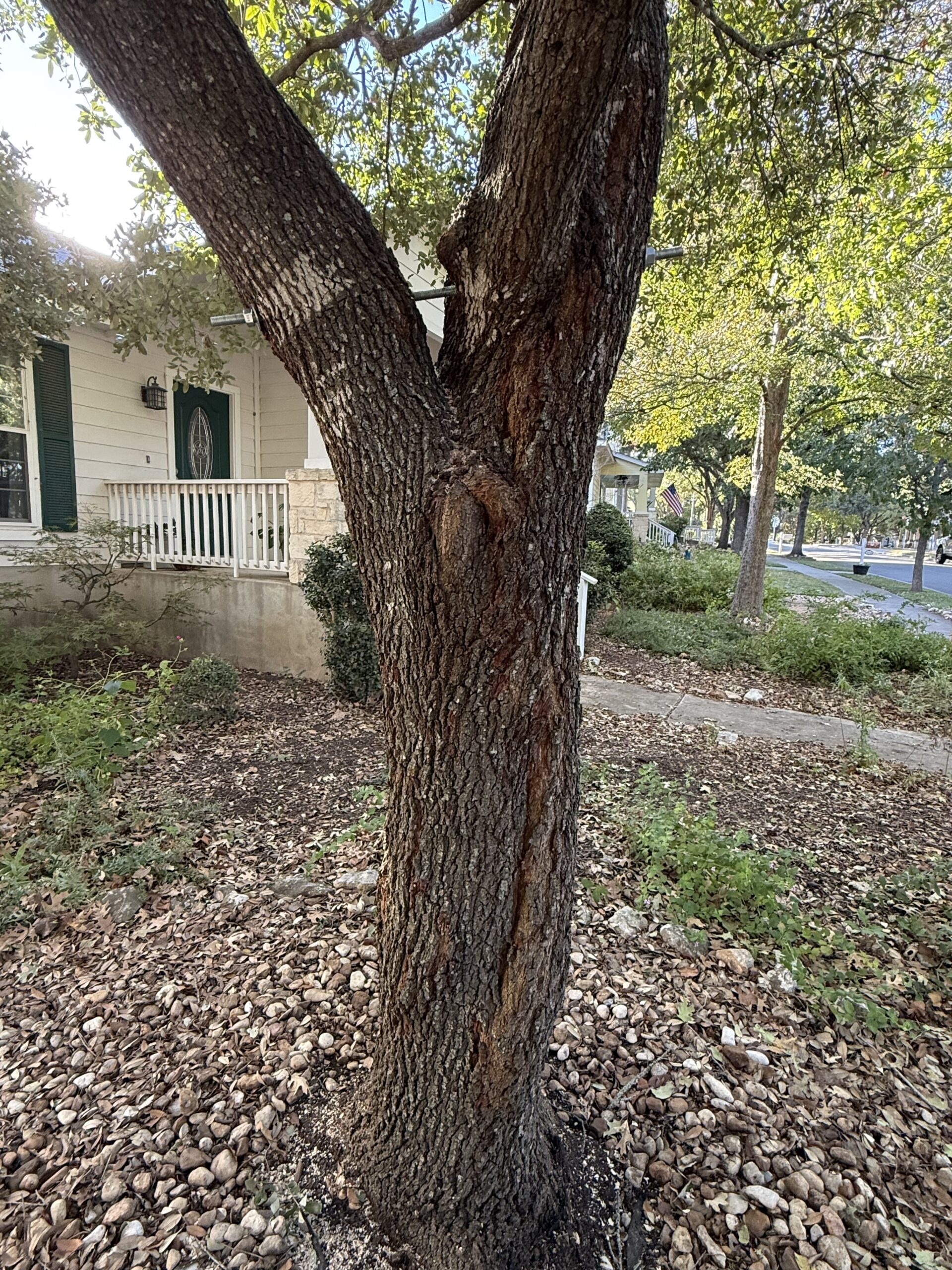
Although pruning can help reduce the overall weight on limbs and unions of trees, it sometimes isn’t enough to restore the tree’s structural integrity. Trees with weak unions, decaying/damaged branches and/or over-extended branches may benefit from tree cabling & bracing. Our Certified Arborists are trained to identify such weaknesses and provide solutions. If you believe you have structurally defective trees, Capitol Tree Care can assess them and offer an appropriate solution.
Dependent on the type of union between stems and branches, the risk of failure can vary. Branches and leaders with sharp angled “V” shaped unions develop “included bark” within the union, causing them to be more prone to failure. To add structure to a weak union(s), the installation of a cabling and/or brace rod system may be recommended. Such systems are dependent on the arrangement and structure of the leaders and branches. Cabling and bracing systems are designed based on each individuals trees needs and overall structure. Cabling and brace rod systems are also best utilized in a preventative manner in attempt to preserve the tree prior to failure instead of an attempt to mitigate a tree that has already has failed, which may become more of a liability. In a situation where failure has occurred, tree removal may be recommended.
Brace rod installation involves drilling through and/or above a union and inserting a thread rod in the drill-site. The threaded rod system is closed on each end with washers and bolts. Threaded bolt rods have a 20,000 lb. tensile strength.
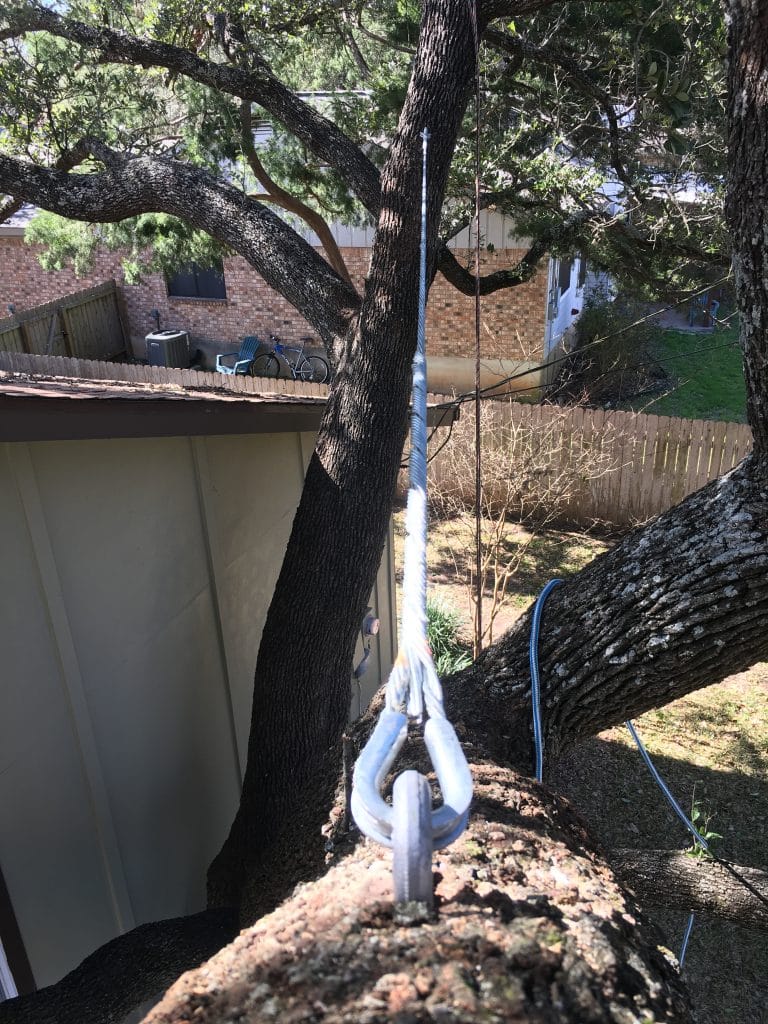
Cabling systems involve the installation of a cable between leaders and/or branches to add structure to a weak union. Cables can also be used to support over-extended, lateral branches. Cabling takes on two forms: Steel Cabling OR Dynamic Cabling.
Steel Cabling
Capitol Tree Care only uses EHS(extra high strength) steel cabling vs. common grade steel cabling, as common grade cabling has a low tensile strength comparatively. To install steel cabling, a hole is drilled at each point of contact and a eye bolt is installed. The cable is fixed to the eye bolts using specialized equipment called thimbles and wire grips. The cable is put under slight tension using a hand winch and terminated at both eye bolts. We utilize multiple size EHS cables, each with a different rating. The largest EHS steel cable we utilize has a rating of 15,400 lbs. Cable size and the overall number of cables required are dependent on each individual tree.
Dynamic Cabling
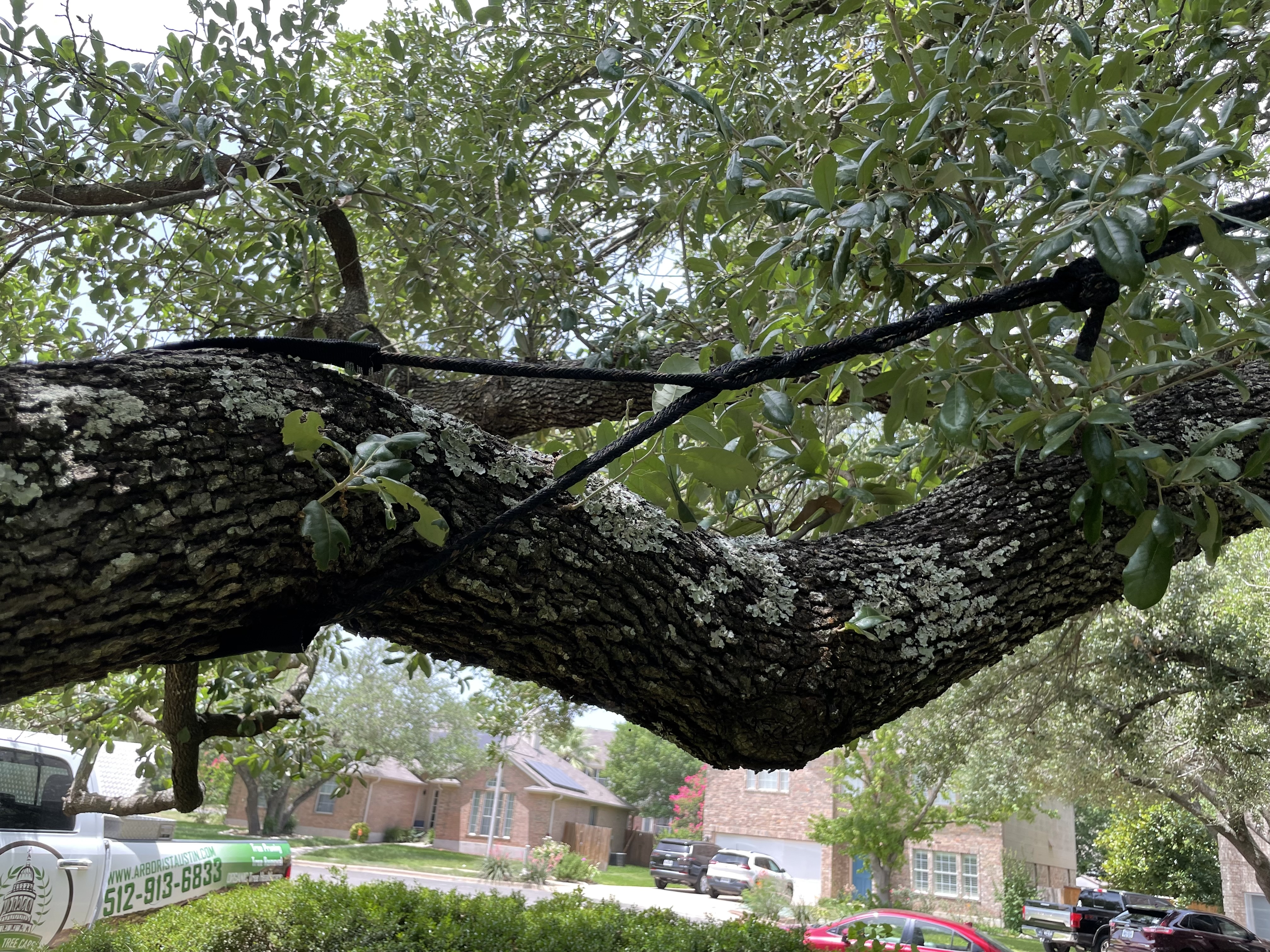
Dynamic Cabling involves the installation of a synthetic rope material instead of a steel cable. NO drilling is required for this type of cable installation, as the cable is wrapped around each point of contact and terminated onto itself by splicing the cable together. The cable at each point of contact is left with enough space to as to not girdle/choke the branch or stem. This cabling system is also put under slight tension using a hand winch. Dynamic cabling is less intrusive as no drilling is required, but the tensile strength is lower than EHS steel cabling. We utilize multiple sizes of dynamic cabling, in which the high tensile strength cable is 10,000 lbs.
Our arborists are equipped with the knowledge and skills to provide best recommendations to reduce your trees risk and increase their structure and safety! Contact us today to setup a free estimate for cabling and bracing.
Bolting Installation
Tree Bolt installation strengthens weak or damaged trees. One of our Certified Arborists will install a specialized bolt to physically reinforce splits and unstable limbs, extending the tree’s lifespan and maintaining its natural beauty. This crucial structural support effectively reduces hazard risks and preserves your green assets.
Our Tree Cabling & Bracing techniques, as well as our high-quality hardware, comply with the American National Standards Institute (ANSI) A300 standards. We are happy to perform annual inspections to check the tensile strength of the cable and to verify that the anchor lags and bolts are working properly and are stable.