
Capitol Tree Care provides reliable and professional tree & stump removal services to residents and businesses throughout Austin, TX and the surrounding areas. Although removing a tree sometimes isn’t the first choice, it is sometimes necessary under certain circumstances. Removing a tree is required when trees become diseased, dead, hazardous, invasive or was simply the wrong tree chosen for its location. When the moment to remove a tree comes, Capitol Tree Care approaches the job the way it should be done — with proper planning, professional equipment, and a team that takes the work seriously.
We serve homeowners and businesses across Austin, Cedar Park, Leander, Round Rock, Pflugerville, Georgetown, Hutto, Lakeway, Buda, Dripping Springs, San Marcos, Lockhart and Bastrop,, and the surrounding Central Texas area.
When Does a Tree Actually Need to Come Down?
If you are unsure if a tree needs to be removed or not, our arborist can assess the tree in person to confirm if removal is genuinely warranted. There are several situations in which tree removal is the right decision.
Common reasons a tree may need to be removed include:
- The tree is dead or in severe decline with no realistic path to recovery
- The tree is fatally diseased and poses a risk of spreading illness to nearby healthy trees
- Significant structural failure (including root issues, trunk damage, or major scaffold limb failure) makes the tree a hazard
- The tree is growing in a location that threatens a structure, foundation, utility line, or neighboring property
- Storm damage has left the tree unstable or in a condition that cannot be corrected through pruning
- The species is invasive or was simply the wrong choice for its location
When you call Capitol Tree Care, an ISA Certified Arborist will evaluate the situation and give you an honest recommendation – not just a sales pitch for a removal job.
Can I Remove a Tree Myself?
This is one of the most common questions we hear, and the honest answer is: it depends on the tree, but in most cases involving any significant size, the risks are not worth it.
Tree removal is one of the most dangerous tasks in the landscape trades. Falling trees and limbs do not behave predictably, especially when a tree is diseased, structurally compromised, or positioned near a structure. A branch or trunk section that shifts unexpectedly during a cut can cause serious injury, structural damage to a home, or damage to underground utilities.
For small, isolated trees well away from structures and utilities, a knowledgeable homeowner may be able to handle the work safely. But for anything larger (and especially for Austin’s mature live oaks, red oaks, ashes and elms growing near homes or fences)professional removal is the right choice.
Beyond safety, there are practical reasons to use a professional service in Austin:
- Austin’s protected tree ordinance applies to certain trees by diameter, and removing them without a permit carries fines and penalties
- Proper insurance coverage protects your property if something goes wrong. Capitol Tree Care carries general liability, workers’ compensation, and auto/equipment insurance
- The equipment required for safe, controlled removal of large trees (rigging gear, aerial equipment, and industrial grinding machines) is not available to most homeowners
The bottom line: if there is any question about the complexity, size, or proximity to structures, a professional evaluation costs far less than the consequences of a removal gone wrong.
CITY OF AUSTIN TREE PERMIT: WE HANDLE IT FOR YOU
Capitol Tree Care Handles Your Austin Tree Permit — Start to Finish
|
Austin’s tree ordinance protects certain trees by size. On residential properties (one- and two-unit), any tree with a diameter of 19 inches or greater requires a permit before it can be removed. On commercial and multifamily properties, the threshold drops to 8 inches or greater. |
|
|
|
Navigating the permit process (understanding what documentation is required, submitting the application correctly, and coordinating with the City of Austin) is unfamiliar territory for most homeowners and property owners. It can also cause delays if not handled properly. |
|
|
|
Capitol Tree Care manages the entire permit process on your behalf. Our arborists will measure your tree to confirm whether a permit is required, prepare all necessary documentation, and submit the application to the City of Austin directly. You do not need to contact the city, fill out forms, or track the permit status yourself, we take care of it. |
|
|
|
This is a genuine advantage of working with a certified arborist rather than a general tree trimming crew. Knowing Austin’s regulations and handling the paperwork correctly is part of the service we provide. |
How Tree Removal Works
Every removal starts with an on-site assessment by a certified arborist. The arborist evaluates the tree’s condition, identifies obstacles and risks on the property, and determines the safest method for removal. We use professional-grade equipment and rigging techniques to control how and where limbs and trunk sections fall, protecting your property throughout the process.
For your protection, Capitol Tree Care carries general liability insurance, workers’ compensation, and auto/equipment insurance. Safe work practices are not optional – they are built into how we do the job.
Once the tree is down, we clear all debris from the site. What happens to the remaining stump depends on the homeowner. We can safely remove the stump if desired, see additional details below.
Stump Grinding: Removing What’s Left Behind
After a tree is removed, the stump is still there. Left in place, stumps are more than an eyesore. They can become a trip hazard, particularly in high-traffic areas of a yard. Over time, the decaying wood attracts insects and pests, which can become a problem near a home’s foundation or other desirable trees. Stumps can also produce new growth from the roots if not addressed.
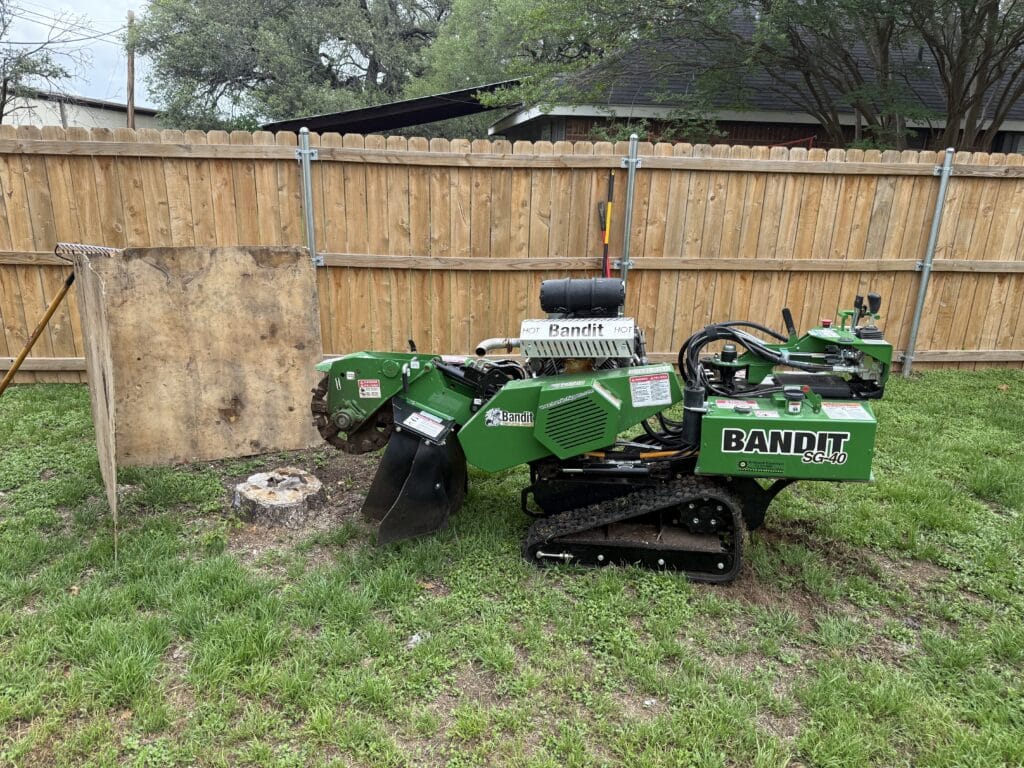
Capitol Tree Care uses a Bandit SG40 stump grinder to remove stumps efficiently and cleanly. The grinding process works by using a rotating cutting disc to chip away the wood and root material until the stump is ground down to 10 to 12 inches below soil grade. The resulting wood chips remain on-site at the grinding location.
To protect your property during the grinding process, we use a tri-guard folding shield positioned between the grinding equipment and anything nearby that needs protection from ejected material. Before any stump grinding work begins, we call Texas 811 (the utility locating service) to have all underground utilities in the work area marked. This step is non-negotiable.
Once the stump is ground down, the area is ready to be filled, seeded, or replanted at your discretion.
Services That Pair Well With Tree Removal
Tree removal rarely happens in a vacuum. Depending on your situation, other services from Capitol Tree Care may be relevant before, during, or after a removal project.
Tree Risk Assessment
If you are unsure whether a tree on your property needs to come down, a formal risk assessment by a Qualified Tree Risk Assessor can provide the clarity you need. James Burtchell, owner of Capitol Tree Care, holds ISA Qualified Tree Risk Assessor credentials and can evaluate trees for structural defects, root health, and overall risk level.
Tree Pruning and Trimming
Not every problem tree needs to be removed. In many cases, strategic pruning by removing deadwood, reducing weight on compromised limbs, or correcting structural issues can extend the life of a tree and eliminate the hazard. Our arborists will always tell you when pruning is a viable alternative to removal.
Cabling
For trees with structural weaknesses that do not yet require removal, cabling can provide supplemental support to extend the tree’s safe life. This is particularly relevant for mature trees with significant sentimental or property value.
Tree Planting
Removing a tree often opens up space and an opportunity. Capitol Tree Care also provides tree planting services, helping you select the right species for your specific location, soil, and site conditions in Austin’s urban environment. Our trained plant healthcare technicians will plant your new tree and give it the boost it needs to grow strong roots in it’s new location.
Organic Plant Health Care
Trees growing near a recently removed tree may benefit from a plant health care assessment. Our arborists can evaluate neighboring trees and recommend soil health or treatment options to protect them or give them a health boost.
Frequently Asked Questions About Tree Removal and Stump Grinding in Austin
How do I know if my tree needs a permit before it can be removed?
In the City of Austin, the permit requirement is based on trunk diameter. On a one- or two-unit residential property, a tree with a diameter of 19 inches or greater requires a permit to remove. On commercial and multifamily properties, any tree 8 inches or greater in diameter is regulated. Capitol Tree Care will measure your tree, confirm whether a permit is required, and handle the entire permit submission process with the City of Austin on your behalf — including all required documentation.
Does Capitol Tree Care handle the permit, or do I have to do that?
We handle it entirely. Our arborists prepare and submit the permit application to the City of Austin for you. You do not need to contact the city, gather paperwork, or manage the process. This is part of the service we provide.
Is it safe to remove a large tree near my house?
Yes, when performed by an insured, professional crew using the right equipment and techniques. Removing a large tree near a structure requires careful planning, proper rigging, and the experience to anticipate how a tree will move during the process. Capitol Tree Care carries general liability, workers’ compensation, and auto/equipment insurance, and our crews follow strict safety protocols on every job.
Do I need stump grinding after tree removal, or can I leave the stump?
You can leave it, but there are good reasons not to. Stumps can become an eye sore or a trip hazard, and as the wood decays it tends to attract insects and pests. Some root systems will also produce new growth if the stump is not removed. Stump grinding eliminates all of these issues and leaves the area ready for landscaping or replanting.
How deep does stump grinding go?
We grind stumps to approximately 10 to 12 inches below soil grade. This is typically sufficient to eliminate surface hazards, prevent regrowth, and prepare the area for filling or replanting. The wood chips generated during grinding are left on-site.
Can you grind stumps close to a fence, foundation, or other structure?
It depends on the specific location, the size of the stump, and what is immediately adjacent to it. Our team will assess the site before the work begins. We call Texas 811 before every stump grinding job to locate and mark public underground utilities in the work area.
How long does tree removal usually take?
It depends on the size of the tree, the complexity of the removal, and conditions on the property. A straightforward removal of a smaller tree may take a few hours. A large, complex removal near a structure can take a full day or more. Your arborist can give you a realistic estimate after the on-site assessment.
Ready to Get Started? Contact Capitol Tree Care
If you have a tree that may need to come down or a stump you are ready to be rid of, the first step is a conversation with a certified arborist. Capitol Tree Care serves Austin and the surrounding Central Texas area, and we are happy to assess your situation, answer your questions, and give you an honest recommendation.
Call us at (512) 913-6833 or submit a request online. We will be in touch to schedule your on-site assessment.